Shadows and Sanctuary: The Art and Engineering of Luxury Low Voltage Lighting
When dusk falls across South Carolina, the architectural narrative of a premium property shouldn’t simply vanish into the dark. Too often, homeowners invest thousands of dollars creating impeccable landscapes, curated gardens, and sweeping outdoor living spaces, only to let them become completely invisible the moment the sun drops below the horizon. Or worse, they flood the property with harsh, blinding commercial floodlights that make the backyard look like an illuminated parking lot.
True luxury illumination is not about blasting a property with as much raw light as possible. It is a delicate, strategic dance between illumination and shadow.
Modern exterior design has completely evolved past high-voltage line systems. Today, creating a breathtaking nighttime sanctuary relies entirely on the precision and flexibility of professional low voltage lighting systems.
When executed by an architectural lighting specialist, these twelve-volt setups do not just keep you from tripping on the pool deck steps; they fundamentally alter how your home feels. They sculpt the landscape, elongate the architecture, and draw the eye across your property, creating a warm, ambient canvas that welcomes you home every evening.

The Technology Paradigm: Line Voltage vs. Low Voltage Systems
To appreciate the design freedom of a modern landscape installation, you must first look at the massive technical shift that occurred beneath the surface of the industry. Historically, exterior illumination relied on standard line voltage. This configuration pulls one hundred and twenty volts of electricity directly from your home’s main breaker panel.
Line voltage systems require heavy, rigid conduits buried deep within trenches. Furthermore, they demand waterproof junction boxes and strict building permits. Because of the sheer power running through those lines, any accidental contact with a stray shovel blade while gardening poses a severe safety hazard.
In contrast, a professional twelve-volt transformer changes the entire equation. By stepping down your home’s one hundred and twenty-volt current to a completely safe twelve volts, a low voltage lighting array delivers incredible performance with a fraction of the physical infrastructure.
The heavy structural conduits are replaced with flexible, direct-burial cables. These thin lines can be tucked delicately around existing root systems, under turf, and through established garden beds. Consequently, this process happens without disrupting your pristine landscaping. Because of this safety and flexibility, design technicians can place fixtures in highly unique locations. For example, they can install lights high up in the canopy of a historic live oak or deep within dense ornamental shrubbery.
Architectural Lighting Typologies: Mapping the Nightscape
Achieving a true resort-style aesthetic across your exterior spaces requires utilizing distinct lighting techniques rather than relying on a single type of fixture. Every architectural feature demands a specific angle, intensity, and beam spread.
Review this spatial layout matrix to understand how professional designers deploy different Twelve-Volt fixtures to maximize visual depth:
| Illumination Technique | Primary Target Feature | Design Objective | Visual Result |
| Up-Lighting | Mature palmettos, column structures, facades | Accentuate height and texture | Creates dramatic vertical focal points |
| Moonlighting | Sprawling oak canopies, driveways | Mimic natural overhead midnight glow | Soft, filtered light casting branch shadows |
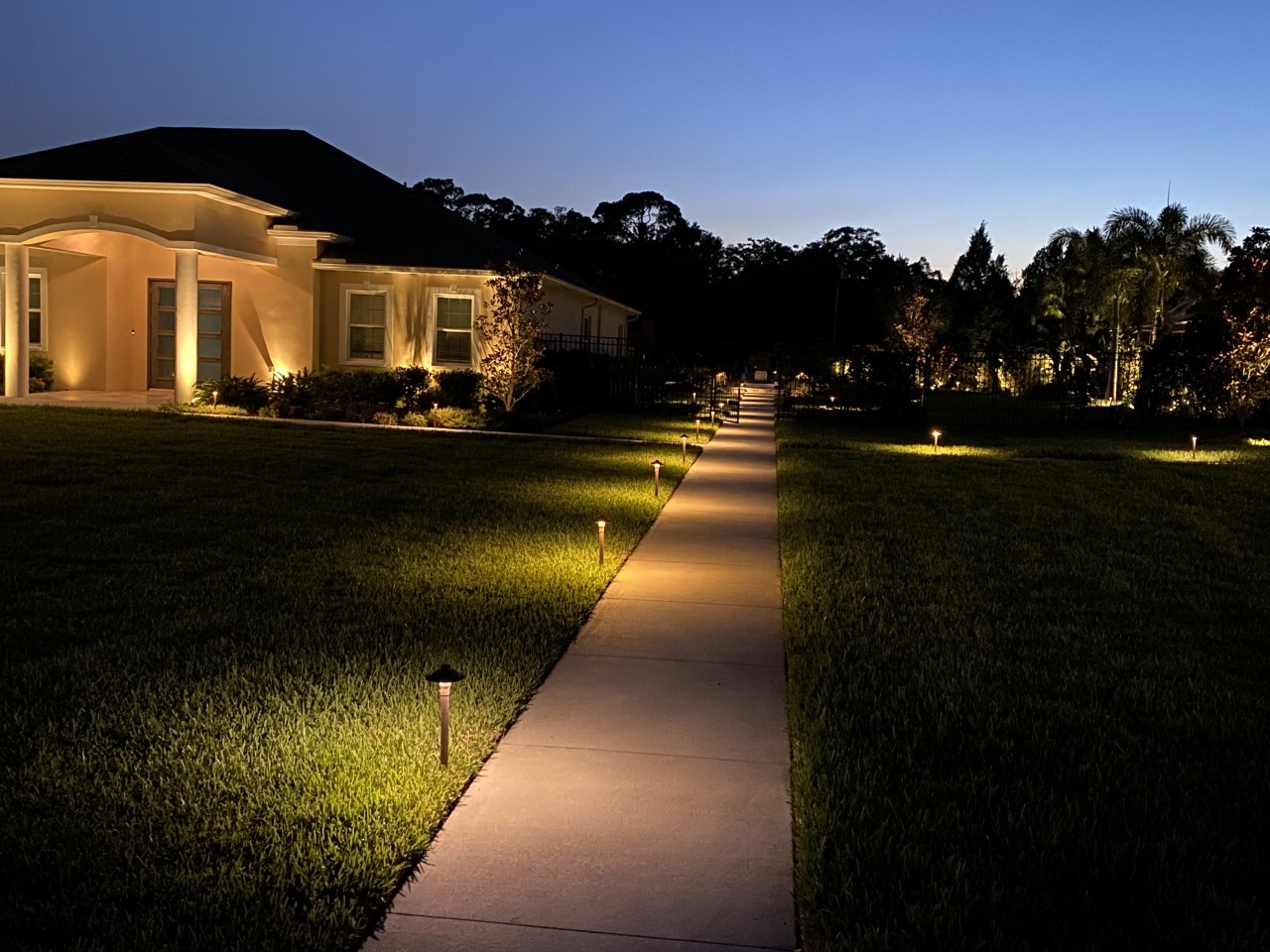
| Path & Step Lighting | Walkways, stone steps, elevation changes | Blend safety with elegant guidance | Glare-free downward pooling of illumination |
| Silhouetting | Sculptural trees, ornamental ironwork | Project clean shapes against a lit wall | High-contrast, artistic structural outlines |
Overcoming the Hidden Challenge of Voltage Drop
While twelve-volt systems offer immense safety and design freedom, they are governed by strict laws of electrical physics that mass-market DIY installers frequently ignore. The most prevalent issue plaguing amateur installations is an engineering phenomenon known as voltage drop.
As an electrical current travels down a length of copper wire, it encounters natural resistance. The longer the wire run, and the more fixtures attached to that run, the more the voltage degrades. If an array starts at twelve volts at the transformer transformer, it might drop to nine volts by the time it reaches the final fixture on the line.
In old incandescent systems, this caused the furthest lights to look dim and yellow. In modern solid-state light-emitting diode (LED) configurations, low voltage can cause the internal drivers to flicker, shift color temperature, or burn out prematurely.
Professional design technicians eliminate this issue entirely through advanced calculations and strategic wiring topology. Rather than running fixtures in a straight daisy-chain line, engineers utilize a hub-and-spoke method or a continuous loop configuration. This ensures that every single integrated LED fixture across your entire property receives identical, clean electrical pressure, resulting in perfectly uniform color temperature and brightness from the first light to the last.
For property owners who want a deeper understanding of electrical principles, load balances, and safety standards, the National Electrical Manufacturers Association (NEMA) provides comprehensive documentation detailing current management across residential outdoor systems.
The LED Revolution: Customizing Color Temperature and Beam Patterns
The true catalyst behind the explosion of high-end low voltage lighting design is the refinement of light-emitting diode technology. Early exterior LEDs were widely disliked by discerning homeowners because they produced a harsh, ghostly blue glare that made natural stone look artificial and foliage look sickly.
Today’s architectural-grade LEDs offer unparalleled control over the visual spectrum. Designers generally utilize fixtures calibrated to a warm two thousand seven hundred kelvins, which perfectly mimics the soft, inviting glow of classic incandescent filaments while using up to eighty percent less energy.
Furthermore, professional fixtures feature interchangeable optics. A designer can adjust the beam spread from a tight, ten-degree spot to highlight a narrow architectural pillar, to a wide, sixty-degree flood to wash a broad brick wall with smooth illumination. This level of precise optical control keeps light exactly where it belongs, preventing light pollution from spilling into your windows or your neighbor’s yard.
Long-Term Capital Preservation: Materials That Defend Against the Elements
Investing in an exterior illumination system means choosing components that can withstand the relentless reality of outdoor exposure. South Carolina properties must endure intense humidity, baking summer heat, torrential seasonal downpours, and corrosive coastal salt air.
Cheap aluminum or plastic fixtures sold at big-box home improvement centers quickly fail under these conditions. Within a year or two, thin aluminum oxidizes, powder coatings flake off, and plastic housings warp or crack, letting water penetrate the internal electronics.
An elite low voltage lighting configuration relies exclusively on architectural-grade materials like solid cast brass or copper. These heavy-gauge metals do not degrade when exposed to moisture or soil acidity. Instead of rusting or peeling, solid brass and copper naturally weather over time, developing a gorgeous, subtle patina that blends into your gardens and landscaping.
These premium fixtures utilize thick silicone gaskets and moisture-sealed chambers to keep the internal LED modules completely isolated from the environment, ensuring your nightscape operates flawlessly for decades.

Experience the Magic with Outdoor Lighting Experts
Your property is a massive investment and a place of deep personal pride. Therefore, it deserves an illumination system that highlights its true beauty, enhances your security, and expands your usable living space long after the sun goes down.
At Outdoor Lighting Experts, we do not simply install lights. Instead, we specialize in custom architectural nightscaping tailored explicitly to the unique homes and landscapes of South Carolina. From dramatic coastal estates to intimate suburban backyards, our experienced design and engineering teams manage every phase of your project with meticulous care. We combine premium, lifetime-warranty cast brass fixtures with advanced engineering principles. Ultimately, this approach delivers a low voltage lighting system that performs beautifully year after year.
Let our team turn your dark property into an illuminated work of art that you can enjoy every single night.
Ready to completely redefine your home’s evening ambiance? Give our expert local team a call today at (843) 224-1422 or visit outdoorlightingexperts.net to schedule your private, custom evening design demonstration!